Understanding the Mental Health Benefits of Meditation
Meditation is a mental practice that involves focused attention, mindfulness, or awareness to train the mind and achieve a state of clarity and emotional calm. Rooted in ancient traditions like Buddhism and Hinduism, it has gained widespread recognition in modern psychology and medicine for its profound mental health benefits.
In an age of constant distraction, overstimulation, and rising stress levels, meditation offers a simple yet effective way to reconnect with the present moment, reduce internal noise, and foster emotional resilience.
Whether practiced through deep breathing, mindfulness, or guided visualizations, meditation is accessible to anyone—no religion, philosophy, or equipment required.
Why meditation for mental health is more relevant than ever
According to the World Health Organization (WHO), mental health conditions such as anxiety and depression affect nearly 1 in 8 people globally. Factors like social media overload, pandemic-related stress, burnout, and lifestyle imbalance have worsened the problem.
Meditation supports mental health by:
-
Reducing stress and cortisol levels
-
Enhancing emotional regulation
-
Improving focus, clarity, and decision-making
-
Lowering symptoms of anxiety and depression
-
Promoting better sleep and overall brain function
These benefits are backed not just by tradition but also by science, with neuroscience and clinical psychology increasingly incorporating meditation into mental health care and self-care programs.
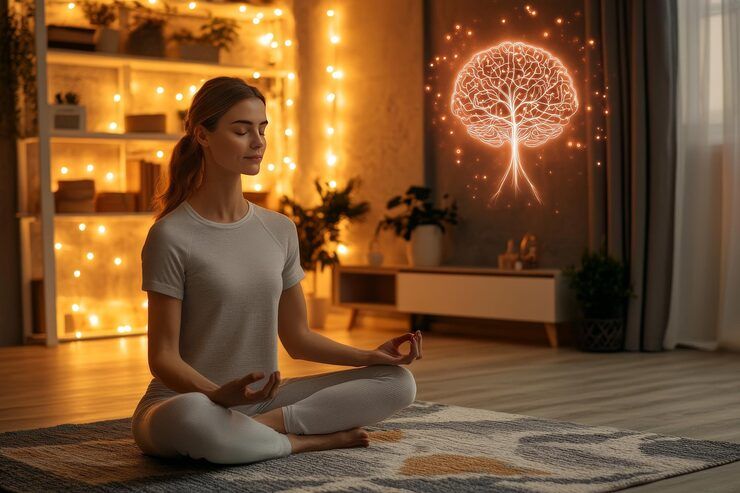
Key mental health benefits of meditation
1. Stress Reduction
Meditation activates the parasympathetic nervous system (the body’s rest mode), slowing heart rate and calming the body.
Studies show that mindfulness meditation significantly reduces cortisol, the stress hormone.
2. Anxiety Relief
Regular meditation reduces overthinking and calms the amygdala—the brain’s fear center.
Mindfulness-Based Stress Reduction (MBSR) programs have been proven effective in reducing generalized anxiety disorder (GAD) symptoms.
3. Improved Emotional Regulation
By creating a space between stimulus and response, meditation helps individuals respond rather than react to difficult emotions.
4. Better Sleep Quality
Meditation reduces mind chatter and induces relaxation, making it easier to fall asleep and stay asleep.
Apps like Calm and Headspace have specific sleep meditations widely used for insomnia.
5. Enhanced Focus and Attention
Focused-attention meditation improves cognitive control and mental endurance, supporting productivity and attention span.
Studies with MRI scans show increased gray matter density in brain regions linked to attention and memory.
6. Increased Self-Awareness and Self-Esteem
Meditation encourages present-moment awareness, which reduces negative self-talk and fosters self-compassion.
Scientific studies and recent developments (2023–2025)
| Study/Organization | Key Finding |
|---|---|
| Harvard University (2023) | 8-week meditation programs show reduction in depression symptoms and emotional fatigue |
| Johns Hopkins University | Meditation performs as well as antidepressants in treating anxiety (meta-analysis) |
| WHO Mental Health Report 2024 | Recommends mindfulness practices in public health policies and workplace wellness plans |
| Stanford Neuroscience Lab | Meditation leads to long-term neuroplasticity changes in the prefrontal cortex |
Types of meditation that support mental health
| Type | Benefits |
|---|---|
| Mindfulness Meditation | Increases present-moment awareness, reduces rumination |
| Loving-Kindness Meditation | Boosts self-worth, empathy, and emotional healing |
| Body Scan Meditation | Improves relaxation, reduces physical and emotional tension |
| Breath-Focused Meditation | Enhances calmness, clarity, and emotional grounding |
| Transcendental Meditation | Reduces anxiety, promotes inner peace |
Mental health policies and awareness campaigns
Many countries are now integrating meditation into health and education systems:
-
India’s AYUSH Ministry supports yoga and meditation as part of national wellness programs.
-
UK’s NHS includes mindfulness as a treatment option for depression and anxiety.
-
UNESCO promotes mindfulness in schools to address rising childhood mental health issues.
-
Workplaces and universities are also adopting meditation spaces and training programs as part of mental health first aid strategies.
Tools and apps to support a daily meditation habit
| Tool/App | Features |
|---|---|
| Headspace | Guided meditations, sleep sounds, mood check-ins |
| Calm | Meditation, breathing exercises, soothing music |
| Insight Timer | 100k+ free meditations, teachers from around the world |
| Smiling Mind | Mindfulness programs for children, teens, and adults |
| MyLife Meditation | Tracks mood and suggests personalized meditations |
Frequently Asked Questions (FAQs)
1. How long should I meditate daily for mental health benefits?
Start with 5–10 minutes a day, and gradually build to 20 minutes. Consistency is more important than duration.
2. Do I need to sit cross-legged or follow a specific posture?
No. You can meditate sitting on a chair, lying down, or walking—as long as you’re comfortable and alert.
3. Can meditation replace therapy or medication?
Not always. Meditation is a powerful support tool but should complement professional mental health care, not replace it.
4. What if my mind keeps wandering?
That’s normal. Gently return your focus to your breath or guide. Each time you do, you're strengthening mental awareness.
5. Are there any side effects to meditation?
For most people, meditation is safe. However, those with trauma or certain psychiatric conditions should consult a therapist before beginning deep practices.
Final thoughts
Meditation is a scientifically supported, accessible, and empowering way to care for your mental well-being. It doesn't require special equipment, space, or belief systems—just a few minutes of stillness and attention each day.
In a world full of noise, meditation offers silence. In a world full of stress, it offers peace. And in a world full of rush, it offers presence.
If you're new to meditation, start small, be gentle with yourself, and trust the process. Over time, the mental clarity, emotional balance, and resilience you gain can truly transform your inner world.